Theory of Change

AFL's theory of change is rooted in one core understanding: when fundamental democratic processes are structurally fair and legally protected, communities can create the change they need.
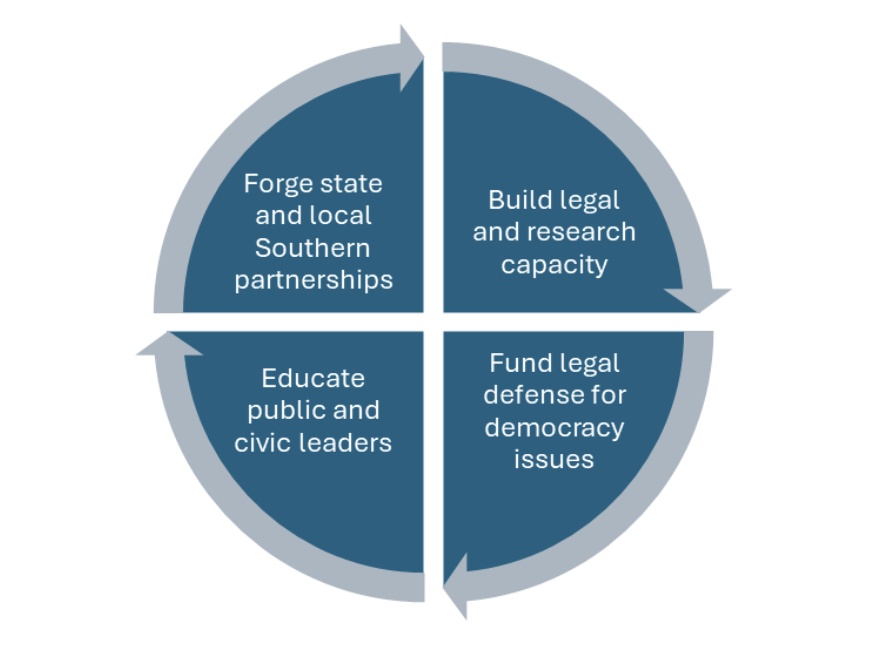
Theory of Change: A circular diagram showing four strategic pillars - Forge state and local Southern partnerships, Build legal and research capacity, Fund legal defense for democracy issues, and Educate public and civic leaders

Because state legislatures—particularly in the South—are increasingly using legal mechanisms to restrict access to direct democracy and manipulate voting maps, AFL's strategy focuses on:

Litigation Support Against Mid-Decade Redistricting

Several Southern states are pushing mid-decade redistricting efforts designed to entrench partisan advantage and diminish the political power of communities of color.

AFL will:

  • Support legal challenges filed by state partners, civil rights attorneys, and impacted community groups
  • Fund expert witnesses, data analysis, public education materials, and legal research
  • Coordinate public communication to ensure communities across the South understand the stakes and know their rights
  • Support grassroots organizing focused on educating communities about redistricting proposals and their impacts

Defense of Citizen-Led Ballot Initiatives

State legislatures in Florida and across the United States are accelerating attacks on citizen-led amendment processes. This includes restrictive signature laws, increased thresholds for passage, and complex procedural barriers.

AFL will:

  • Provide legal research and litigation support challenging unconstitutional restrictions
  • Work with partners to strengthen long-term legal protections for direct democracy
  • Produce and disseminate educational materials explaining these threats to the public

Three-Year Strategy

Over its first three years, AFL will scale from a small legal-support nonprofit to a regional defender of democratic rights.

Year 1: Foundation and Rapid Response

  • Build core staff and establish governance, compliance, and fiscal systems
  • Launch initial litigation support projects
  • Develop partnerships in priority states (FL, TX, AL, SC, LA, and MO)
  • Establish a robust fundraising program

Year 2: Growth and Capacity Building

  • Develop a permanent Southern Democracy Protection Fund for rapid-response legal needs
  • Launch a research and policy unit to track attacks on direct democracy and redistricting
  • Increase partner capacity through trainings, toolkits, and subgrants

Year 3: Regional Anchor Institution

  • Establish AFL as the primary 501(c)(3) litigation support hub for democracy protection in the South
  • Publish annual reports on state-level threats to democracy
  • Expand partnerships to all Southern states
  • Strengthen long-term infrastructure for proactive litigation